
For Every Business Owner
Who Deserves The Ultimate Pay Day




ATTENTION BUSINESS OWNERS:
Do You Have An Exit Strategy?
Would You Like To Sell Your Business One Day?
How Much Is Your Business Worth and …
Will Someone Buy It?
For Business Owners who want to maximise the sale value of their
business, retire with more cash in the bank… and enjoy more
lifestyle choices… the time to act is now!
Business Valuation Methods
Business valuation can be a tricky assignment to take on. There’s no universally accepted perfect way to do it, and you’ll often get completely different values of what a business is worth from different business valuation methods you might try.
When you are valuing a business, it is important to try and arrive at the most accurate figures that you can, but to some extent you will be hampered in your efforts by the fact that there are so many intangibles that can strongly influence the true value, and which don’t make their way into the financial statements.
The right (or, at least, best) method to use depends on many things, and the most important thing is the size of the business being evaluated.
Small businesses are more volatile, their figures are more likely to undergo wild swings, and their rise or fall at any particular moment is determined almost entirely by external market dynamics.
Big businesses are not subject to the same market forces, and they’re more easily able to absorb unfavourable market conditions and still come out with strong profit figures.
Not surprisingly, therefore, the methods used for valuing small business should focus equally on internal and external factors, whereas big business valuation methods can skip over some of the externals except when they are particularly profound.
As a good example of this principle in action, the entire travel industry was profoundly affected by the terrorist attacks of September 11, 2001. The devastation to the industry was unprecedented, and no other terrorist attack in history had anywhere near the impact on travel industry statistics as this event did.
However, by and large, the major hotel chains, airlines, and cruise lines were only slightly inconvenienced by the aftermath of the event. For many smaller hotels, restaurants, and touring businesses, it was a serious disaster that drastically affected their profitability, and even caused a large number of these small businesses to fold.
The NPV method
Using the NPV (Net Present Value) method for business valuation is the quickest and most commonly employed method. It is based entirely on the balance sheet information. As you probably already guessed, this method is clearly more suitable for deciding the value of a big business and almost useless in deciding the value of a small business.
That’s not to say you can’t use it for evaluating a small business, but the figures returned will be far from an accurate picture, because market dynamics aren’t taken into consideration at all, nor are any other external factors.
The TMV method
This is the Total Market Value of all tangible assets, intangible assets (intellectual property and so on) owned by the company, and then adjusted according to things like total volume of sales, annual profit and loss, and various other factors that will be expected to influence the total market value of the business.
The FMV method
Using the Fair Market Value method, you are getting quite close to the way accountants write down assets to attempt to minimise the tax you’ll pay on them. This means there is some risk of undervaluing assets because the amount you would get if you sold an asset is not exactly the same thing as the value of that asset to the business.
For example, a used chocolate stirring machine that is 25 years old might not attract anywhere near the selling price of a brand new chocolate stirring machine, and yet it may be a true workhorse that has allowed the company to produce millions of tons of chocolate over 25 years without any problems.
This machine may not have all the latest technology, but it gets the job done. The newer machine possibly has all kinds of sensors and other fancy technology that helps to improve the way it does its job, but it may also be more likely to break down more quickly, because the priority for those who made it was not to build something that would last.
So in this scenario the actual value of the old stirring machine is higher than it’s fair market value, because it generates more value than it loses, and is not disadvantaged merely by being old.
A buyer of the business is more likely to care about things like yield, cost of ownership, and profit margins than to care about the technical abilities of the machine itself.
So which method should you use?
The simple answer is none of them. You shouldn’t use any method to value a business because you are not a professional business valuer. You should turn this job over to experts who do nothing else all day but value businesses.
Where can you find such experts? The best place you’ll find expert business valuers is at The Exit Strategy Group, a Melbourne based business with expert consultants who assist clients with numerous tasks related to planning their exit from business ownership.
The Exit Strategy Group can assist in working out how to calculate what your business is worth, how to value your business, business succession planning, how to sell a small business and transition planning.
In this breakthrough book, you will discover there’s more to a profitable
exit strategy than just selling your business…with answer to these and
many more myths believed by countless business owners :
 Myth #1: I don’t need an exit strategy until I’m ready to sell my business
Myth #2: I can’t afford to dedicate the time involved with exit planning
Myth #3: The wealth of my business is defined by how much I earn
Myth #4: If I have a growth strategy, why do I need an exit strategy?
Kerry Boulton, CEO and Founder of The Exit Strategy Group and NEXUS Business
Coaching, is Australia’s most respected exit strategy advisor. With over 20 years in
business as an entrepreneur, transformative coach and consultant, sought-after
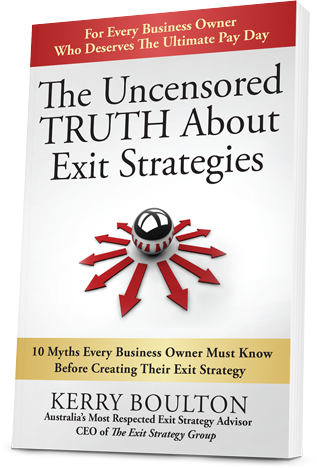
speaker and talented facilitator, Kerry wrote The Uncensored TRUTH About Exit
Strategies to help as many business owners as she can to monetise the wealth that’s lying in their businesses.
The Uncensored TRUTH About Exit Strategies details how to build a strong and
successful exit plan, which is an absolute must if you want to get full value from
any sale. Kerry exposes and debunks many myths and gives you practical advice. She
walks you through what most people don’t know – or refuse to believe – about the
process of planning their exit.
Kerry believes exit planning is a process, not a destination. She helps you overcome
challenges you’re likely to face as a business owner and most important, the steps to
ensure you find financial freedom and do not become just another statistic.

The Cold Hard Facts You NEED to Know If You Want To Sell Your Business Someday
81% of Australian business owners plan to retire in the next 10 years
53% of them have no exit strategy
22% will shut shop*
How To Increase The Value of Your Business By Up To 71%* In Just 24 Months …and Have the Biggest Pay Day of Your Life
*Based on actual client results to date
Are you ready for the huge wave of business sales looming on the horizon and a lot of potential competition? Buyers will be picking and choosing only the best. Email info@TheExitStrategyGroup.com.au and ask for your FREE Value Builder Report.
AND…when you order your FREE copy of my book, The Uncensored Truth About Exit Strategies” you’ll find out …
…there’s a lot more to your Exit Strategy
than a succession plan or just selling your business…
You’ve worked hard for years building your business. You know how much value you’ve created and it’s worth plenty to someone who can take it to the next level.
The question is – how do you even start thinking about your exit plan when you aren’t anywhere near ready to exit or sell your business?
The gap between the idea of selling – or creating any sort of succession plan – and actually getting the deal on the table on your terms and at the time you want – can be very wide and very deep.
The fact is…only 20% of business owners who say they plan to sell their business ever make it their ultimate pay day.
That’s a very sobering statistic. Will you be in the 20% who do?
Many business owners simply don’t know what they need to know to prepare for succession, transition of ownership and exit. Exit strategies are not just about making money, Business owners often have other goals such as establishing a legacy, ensuring the business remains in their family, or continuing to have a say in what happens in the business.
…No matter what exit strategy you choose – you can guarantee your best outcome by simply this: PLANNING IN ADVANCE. There are immediate benefits to getting started preparing your exit strategy. You don’t have to wait for the exit date before claiming more of your wealth!
Exit strategies are something every investor looks for… The questions are the same – no matter what the size of the business. How am I going to get my money out?And how much are you going to get as the owner?
Having an exit strategy worked out in advance helps ensure you like the answers to those questions and gives you some control over your business’s future.