
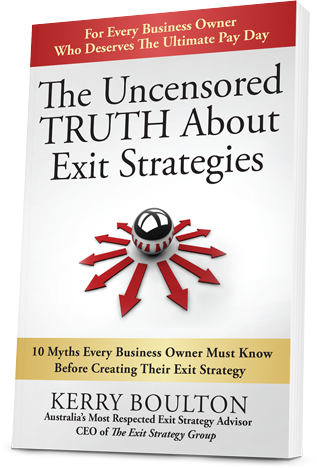
For Every Business Owner
Who Deserves The Ultimate Pay Day





ATTENTION BUSINESS OWNERS:
Do You Have An Exit Strategy?
Would You Like To Sell Your Business One Day?
How Much Is Your Business Worth and …
Will Someone Buy It?
For Business Owners who want to maximise the sale value of their
business, retire with more cash in the bank… and enjoy more
lifestyle choices… the time to act is now!
Succession Plans
Succession plans are important for all small businesses, and most especially those that consider themselves to be family businesses.
Knowing who can take over the business, when, how, and why. That’s what a succession plan is all about. If you think you’ve already go that covered, then wait, because there are probably some things you haven’t thought about yet.
There are all kinds of circumstances that could come up affecting how and when you leave the business. For example, what if you suddenly became very ill? Is there someone you can trust right now to take over your business and keep it running until you’re up and about again?
Or would you have to hang up a sign in the window saying “Closed due to illness”? Think of all the money you lose for every day that your business is closed. Think of the inconvenience it causes to your customers. And think of the possibility of some of your long term loyal customers going to your competitors, perhaps forever.
These painful mental images are of completely realistic scenarios, but they’re also avoidable scenarios. If you make plans early on, you never have to worry about your business failing due to your temporary or permanent absence.
Here are the things you should always make sure of before settling on a transition plan:
1. Make it clear who you expect to be your successor
This is important because you don’t want to have problems where family members are squabbling and fighting about who should be in charge. The matter should be clear cut and sharply defined, however it is also a matter that should be decided fairly.
It’s also not a matter that is entirely yours to decide. You can’t force a person to be your successor. That will surely backfire. You may find that the person you intend to be your successor has other plans of their own, and no interest at all in running your business ever.
Another thing to consider is that you might not make a single person the successor, and you definitely don’t have to. You could split control of the business between different individuals. Just be mindful of the different personalities involved and make sure you make your decisions based on what will best help the business to survive.
2. Make sure any chosen successors have necessary training
This is a no-brainer, but you’d be amazed how many people actually don’t think about this aspect of preparing their successor to take over the business. Training could be formal or informal, depending on the nature of the task. The most important thing is that the individual should have the necessary skills to handle all of their responsibilities adequately.
3. Provide opportunities to gain experience
Training is a good start, but without real on-the-job experience, training does not always provide sufficient grounding to ensure a smooth start to a business career.
Granted, running a business that has already been set up and is already operating well is a lot easier than starting a new business, but that doesn’t mean it won’t be challenging for the person who will now be responsible for it.
4. Make it formal
A most important step. You need your whole succession plan in writing and all the official documentation prepared and ready to sign at a moment’s notice.
As the classic saying goes, your plans will only fail if you fail to plan. So make sure everything is ready before you need it to be ready.
5. Prepare for multiple scenarios
Developing a succession plan is a good start, but in reality you’ll need to plan ahead for different eventualities. You’ll need a plan for what happens if you’re temporarily unable to run the business for some time, a plan for what will happen if you’re permanently unable to run the business, and a plan for what will happen if the chosen successor is unavailable, unable, or unwilling to take over when the time comes.
Don’t forget to also make sure your successor understands the importance of developing his or her own succession plan.
6. Decide if you want a clean break
It’s not always the case that you might want to completely remove yourself from the business. You may want to keep a stake in it. You may even want to keep a controlling stake in it (in which case you’ll need to retain at least a 51 percent share). Just be aware that if you retain shares in the business you’ll have responsibilities as well. On the other hand, you’ll also be eligible for income or dividends from the profits.
None of these decisions will be easy to make. If you need some help, there are expert consultants at The Exit Strategy Group who can advise you. This Melbourne based business helps people all around Australia to prepare for their exit, and can help you, too.
In this breakthrough book, you will discover there’s more to a profitable
exit strategy than just selling your business…with answer to these and
many more myths believed by countless business owners :
 Myth #1: I don’t need an exit strategy until I’m ready to sell my business
Myth #2: I can’t afford to dedicate the time involved with exit planning
Myth #3: The wealth of my business is defined by how much I earn
Myth #4: If I have a growth strategy, why do I need an exit strategy?
Kerry Boulton, CEO and Founder of The Exit Strategy Group and NEXUS Business
Coaching, is Australia’s most respected exit strategy advisor. With over 20 years in
business as an entrepreneur, transformative coach and consultant, sought-after
speaker and talented facilitator, Kerry wrote The Uncensored TRUTH About Exit
Strategies to help as many business owners as she can to monetise the wealth that’s lying in their businesses.
The Uncensored TRUTH About Exit Strategies details how to build a strong and
successful exit plan, which is an absolute must if you want to get full value from
any sale. Kerry exposes and debunks many myths and gives you practical advice. She
walks you through what most people don’t know – or refuse to believe – about the
process of planning their exit.
Kerry believes exit planning is a process, not a destination. She helps you overcome
challenges you’re likely to face as a business owner and most important, the steps to
ensure you find financial freedom and do not become just another statistic.

The Cold Hard Facts You NEED to Know If You Want To Sell Your Business Someday
81% of Australian business owners plan to retire in the next 10 years
53% of them have no exit strategy
22% will shut shop*
How To Increase The Value of Your Business By Up To 71%* In Just 24 Months …and Have the Biggest Pay Day of Your Life
*Based on actual client results to date
Are you ready for the huge wave of business sales looming on the horizon and a lot of potential competition? Buyers will be picking and choosing only the best. Email info@TheExitStrategyGroup.com.au and ask for your FREE Value Builder Report.
AND…when you order your FREE copy of my book, The Uncensored Truth About Exit Strategies” you’ll find out …
…there’s a lot more to your Exit Strategy
than a succession plan or just selling your business…
You’ve worked hard for years building your business. You know how much value you’ve created and it’s worth plenty to someone who can take it to the next level.
The question is – how do you even start thinking about your exit plan when you aren’t anywhere near ready to exit or sell your business?
The gap between the idea of selling – or creating any sort of succession plan – and actually getting the deal on the table on your terms and at the time you want – can be very wide and very deep.
The fact is…only 20% of business owners who say they plan to sell their business ever make it their ultimate pay day.
That’s a very sobering statistic. Will you be in the 20% who do?
Many business owners simply don’t know what they need to know to prepare for succession, transition of ownership and exit. Exit strategies are not just about making money, Business owners often have other goals such as establishing a legacy, ensuring the business remains in their family, or continuing to have a say in what happens in the business.
…No matter what exit strategy you choose – you can guarantee your best outcome by simply this: PLANNING IN ADVANCE. There are immediate benefits to getting started preparing your exit strategy. You don’t have to wait for the exit date before claiming more of your wealth!
Exit strategies are something every investor looks for… The questions are the same – no matter what the size of the business. How am I going to get my money out?And how much are you going to get as the owner?
Having an exit strategy worked out in advance helps ensure you like the answers to those questions and gives you some control over your business’s future.